Singapore Infrastructure Updates: 10 Major Developments Shaping
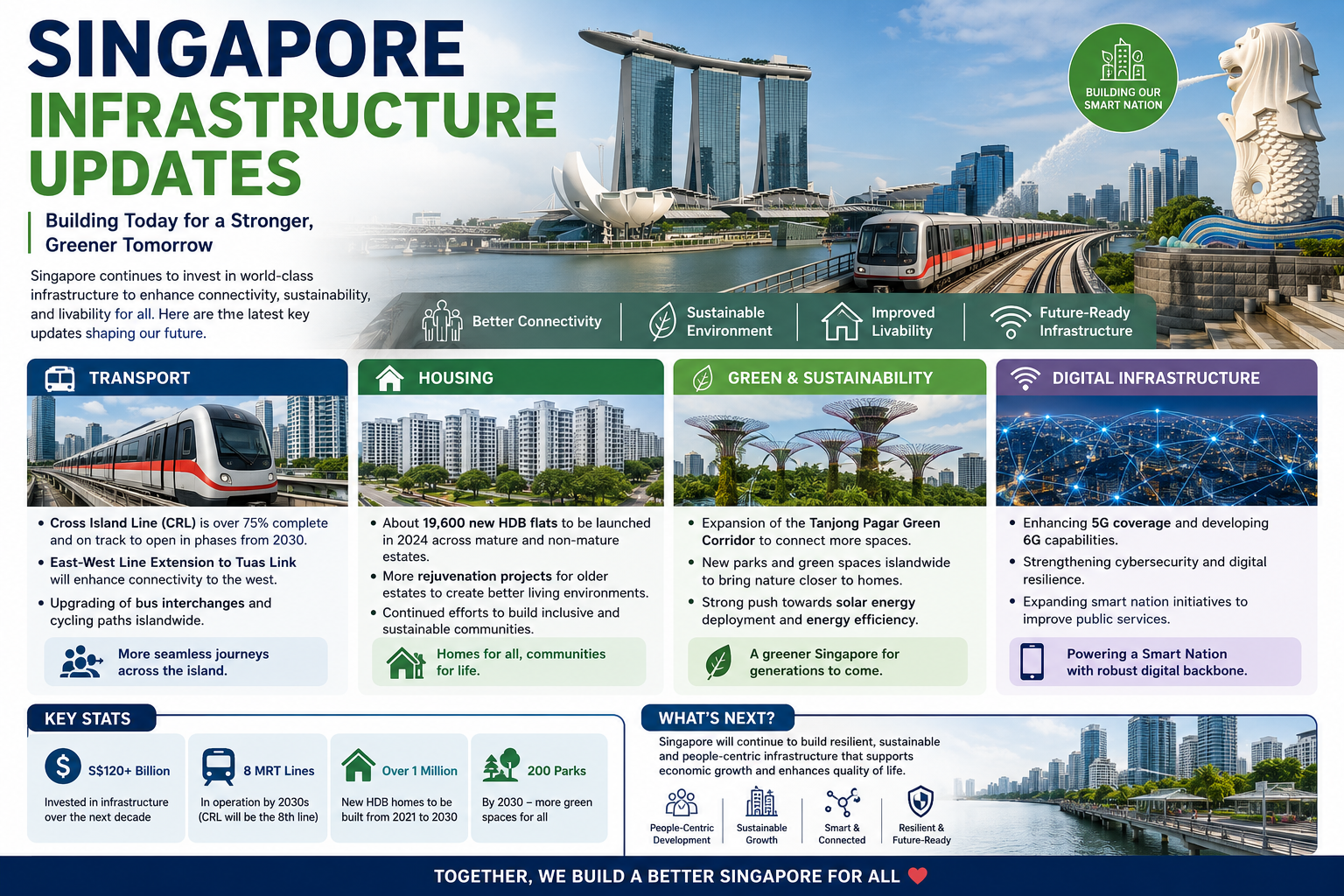
Singapore never stands still. If you’ve visited the city-state a few years apart, you’ve probably noticed something different every time—new MRT stations, greener neighborhoods, expanded airports, smarter roads, or entirely new districts appearing where empty land once existed.
That’s exactly why Singapore infrastructure updates continue to attract attention from residents, businesses, investors, and travelers alike. The country’s long-term planning has earned a global reputation for creating efficient transport systems, sustainable communities, and world-class public facilities.
And the interesting part? Many of the biggest projects are still underway.
Let’s look at the most significant infrastructure developments transforming Singapore today.
1. Changi Airport Terminal 5 Is Taking Shape
Few infrastructure projects are as ambitious as Changi Airport’s Terminal 5.
Designed to support Singapore’s growing role as a global aviation hub, the new terminal will dramatically increase passenger capacity once completed. It will also introduce advanced automation, faster baggage handling, and smarter immigration systems.
Some expected highlights include:
- Larger passenger terminals
- Improved aircraft parking capacity
- Automated check-in technology
- Sustainable building features
- Better connections with public transport
Once operational, Terminal 5 will help future-proof Singapore’s aviation industry for decades.
2. MRT Network Expansion Continues
Singapore’s Mass Rapid Transit (MRT) system keeps getting better.
New lines and station extensions are reducing travel times while making previously less accessible neighborhoods easier to reach.
Current expansion projects include:
- Cross Island Line
- Jurong Region Line
- Thomson-East Coast Line extensions
These developments aren’t just about convenience.
They’re designed to reduce dependence on private vehicles while encouraging greener urban mobility.
For commuters, that means fewer transfers, shorter journeys, and more transportation choices.
3. Tuas Mega Port Is Transforming Global Shipping
Singapore has long been one of the world’s busiest ports.
Now, the Tuas Mega Port is taking maritime operations to another level.
When fully completed, it will consolidate existing container terminals into one highly automated facility featuring:
- Driverless vehicles
- Automated cranes
- AI-powered logistics
- Digital cargo management
The project will significantly improve shipping efficiency while maintaining Singapore’s position as one of the world’s leading maritime hubs.
Pretty impressive… and it’s only getting bigger.
4. Punggol Digital District Is Becoming a Smart City Model
The Punggol Digital District represents the future of integrated urban planning.
Rather than simply building offices, Singapore is creating an innovation ecosystem where technology companies, universities, research institutions, and residents coexist within one connected district.
Features include:
- Smart energy management
- Digital infrastructure
- Autonomous vehicle testing
- Green public spaces
- Mixed-use developments
The district aims to become a global showcase for smart city technologies.
5. More Green Buildings Across Singapore
Sustainability is no longer optional.
One noticeable trend in recent Singapore infrastructure updates is the rapid adoption of environmentally friendly buildings.
Many new developments now include:
- Solar panels
- Rainwater harvesting
- Natural ventilation
- Energy-efficient lighting
- Green roofs
- Vertical gardens
Singapore continues investing heavily in reducing carbon emissions while maintaining its high urban density.
And honestly… it shows.
6. New Housing Estates Focus on Community Living
Public housing remains one of Singapore’s greatest strengths.
But today’s Housing & Development Board (HDB) projects go far beyond apartment blocks.
Modern estates increasingly feature:
- Community gardens
- Cycling paths
- Healthcare facilities
- Childcare centers
- Smart parking systems
- Senior-friendly amenities
The goal isn’t just housing people.
It’s building neighborhoods where residents genuinely enjoy living.
7. Smart Traffic Systems Improve Daily Commutes
Traffic management has become increasingly intelligent.
Singapore continues introducing advanced systems that monitor road conditions in real time and adjust traffic signals automatically.
Recent improvements include:
- AI traffic monitoring
- Digital road pricing enhancements
- Smart pedestrian crossings
- Connected traffic lights
These technologies reduce congestion while improving road safety for everyone.
Small upgrades individually.
Big difference collectively.
8. Climate Resilience Projects Protect the Future
Climate change presents serious challenges for coastal cities.
Singapore has responded by investing in long-term resilience projects.
Infrastructure initiatives include:
- Coastal protection systems
- Flood prevention upgrades
- Larger drainage canals
- Reservoir improvements
- Sea-level adaptation planning
These projects are designed to protect homes, businesses, and public infrastructure from future climate risks.
Planning decades ahead has always been one of Singapore’s defining characteristics.
9. Healthcare Infrastructure Keeps Expanding
Healthcare demand continues growing alongside Singapore’s aging population.
New hospitals, integrated medical campuses, and community healthcare centers are expanding nationwide.
Key priorities include:
- Faster patient access
- Modern medical technology
- Larger treatment capacity
- Better eldercare services
Healthcare infrastructure isn’t always the headline project people notice.
But it’s one of the most important investments being made.
10. Digital Infrastructure Powers the Smart Nation Vision
Physical infrastructure is only part of the story.
Singapore is equally focused on digital infrastructure.
The Smart Nation initiative continues expanding technologies like:
- Nationwide digital services
- High-speed broadband
- Cybersecurity upgrades
- AI-powered public services
- Cashless payment systems
- Smart sensors
These digital systems support everything from transportation and healthcare to education and public safety.
The result?
A more connected, efficient, and responsive city.
Why Singapore Infrastructure Updates Matter
Infrastructure affects nearly every aspect of daily life.
Whether someone is commuting to work, shipping goods internationally, starting a business, or simply enjoying public parks, these investments improve efficiency and quality of life.
Singapore’s approach focuses on long-term planning rather than short-term fixes.
Projects are often designed decades before completion, ensuring future generations benefit from today’s investments.
That’s one reason international urban planners frequently study Singapore’s development model.
What Can Residents and Businesses Expect Next?
Looking ahead, several trends are likely to shape future infrastructure projects.
Expect continued investment in:
- Sustainable transportation
- Renewable energy
- Smart city technology
- Digital public services
- Climate adaptation
- Urban redevelopment
- Autonomous mobility
- Green architecture
The pace of development isn’t slowing anytime soon.
If anything, innovation is accelerating.
Final Thoughts
Keeping up with Singapore infrastructure updates offers valuable insight into how one of the world’s most forward-thinking nations prepares for the future.
From expanding MRT lines and the Tuas Mega Port to smart districts, green buildings, and digital transformation, every project contributes to a broader vision of sustainable, connected urban living.
While many cities react to change, Singapore has built its reputation by planning ahead. And that’s exactly why its infrastructure continues to attract global attention.
As new projects move from blueprint to reality, residents, businesses, and visitors can expect an even smarter, greener, and more efficient Singapore in the years ahead.