Singapore Cloud Services: Guide to Providers, Costs & Security
Singapore Cloud Services are now part of the IT setup for many businesses, from small startups to large enterprises. Instead of relying only on physical servers and on-site hardware, companies can access computing power, storage, databases, software, backup, and security through cloud platforms.
For Singapore businesses, cloud computing can support remote work, online applications, data management, business continuity, and faster expansion. SMEs can use cloud storage, hosted software, and managed cloud services without building a large IT infrastructure. Larger companies may use hybrid cloud, multi-cloud, AI workloads, and advanced data systems for more demanding operations.
The main cloud service models include IaaS, PaaS, and SaaS, while public, private, and hybrid cloud options suit different business requirements. Providers such as AWS, Microsoft Azure, Google Cloud, Oracle Cloud, and other cloud companies serve businesses operating in Singapore.
This guide looks at cloud service types, leading providers, cost factors, security, SME use cases, migration, and the role of cloud technology in Singapore’s digital economy.
What Are Singapore Cloud Services?
Singapore Cloud Services are internet-based services that give businesses access to computing power, storage, software, databases, and other IT resources without depending entirely on physical equipment at their office.
For businesses searching for cloud services Singapore, the main advantage is flexible access to technology. Cloud computing Singapore companies can use remote servers to store files, run applications, host websites, manage data, and create backups through an internet connection.
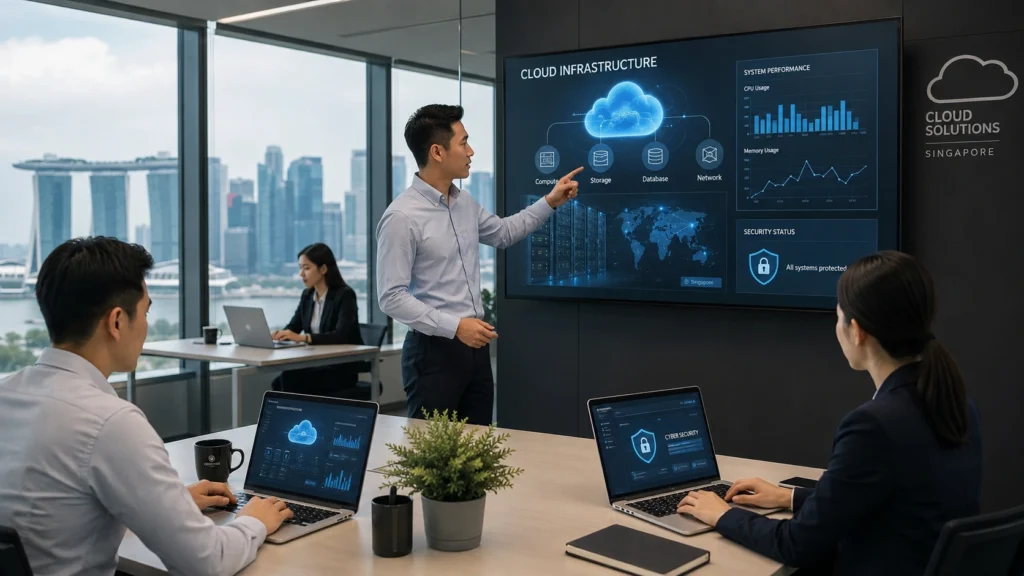
A cloud platform provides the environment where these services run, while the cloud provider manages the underlying servers, networking, and other cloud infrastructure. Businesses can choose services based on their size, workload, security needs, and budget.
Traditional IT infrastructure usually requires a company to purchase and maintain its own servers, storage devices, and networking equipment. A business cloud model shifts much of this setup to a cloud provider, reducing the need for on-site hardware and making it easier to increase or reduce resources as business requirements change.
Types of Cloud Services in Singapore
Businesses in Singapore can choose different cloud models based on their workload, budget, security requirements, and technical needs. The three main service models are IaaS, PaaS, and SaaS, while public, private, hybrid, and multi-cloud describe how cloud resources are deployed.
Infrastructure as a Service (IaaS)
IaaS provides virtual servers, storage, networking, and computing resources. Businesses can control their operating systems and applications without purchasing physical servers. It suits companies that need flexible IT infrastructure for websites, databases, and business applications.
Platform as a Service (PaaS)
PaaS gives developers a ready environment for building, testing, and deploying applications. The provider manages much of the underlying infrastructure, allowing development teams to focus on application code and features.
Software as a Service (SaaS)
SaaS delivers ready-to-use software through the internet. Email, accounting platforms, CRM tools, project management software, and collaboration applications are common examples.
Public, Private and Hybrid Cloud
A public cloud shares provider-managed infrastructure across customers. A private cloud is dedicated to one organisation. A hybrid cloud combines private infrastructure with public cloud resources.
Multi-Cloud
Multi-cloud means using services from two or more cloud providers. A business may use one provider for databases and another for analytics, backup, or specialised workloads.
| Cloud Type | What It Provides | Best For | Common Use |
| IaaS | Servers, storage, networking | IT teams | Websites and databases |
| PaaS | Application development environment | Developers | App development |
| SaaS | Ready-to-use software | Businesses | CRM and collaboration |
| Public Cloud | Shared provider infrastructure | SMEs and startups | Hosting and storage |
| Private Cloud | Dedicated cloud environment | Larger organisations | Sensitive workloads |
| Hybrid Cloud | Public + private resources | Growing businesses | Flexible IT operations |
| Multi-Cloud | Services from multiple providers | Larger IT teams | Workload distribution |
Why Singapore Businesses Are Moving to Cloud Services
Singapore businesses are shifting to cloud services because they can access IT resources without buying and maintaining large amounts of physical hardware. From small startups to established enterprises, cloud solutions for Singapore businesses can support everyday operations and long-term technology plans.
The main reasons include:
- Lower upfront costs: Businesses can avoid large investments in servers and related equipment.
- Easy scalability: Cloud resources can be increased or reduced as workloads change.
- Faster deployment: New applications, storage, and computing resources can be set up quickly.
- Remote access: Teams can work with approved files and applications from different locations.
- Better backup: Cloud backup can protect important business data and support recovery after system problems.
- Business continuity: Cloud-based systems can help companies keep important operations running during disruptions.
- Support for digital transformation: Cloud technology provides a base for online applications, automation, analytics, and modern business software.
For Singapore SMEs, cloud services can provide useful IT capabilities without requiring a large internal technology team. Startups can also launch and expand digital products with fewer hardware requirements, while larger companies can use business cloud services for complex workloads and enterprise applications.
Popular Cloud Services for Singapore Businesses
Businesses can choose individual cloud services or combine several of them based on their daily operations, data needs, and IT setup. Here are the services most commonly used by Singapore companies.
Cloud Hosting
Cloud hosting Singapore businesses ko websites, applications, and online platforms run karne ke liye scalable server resources deta hai. Resources can be adjusted as traffic changes.
Cloud Storage
Cloud storage Singapore services provide online space for documents, media, business files, and shared data. Teams can access authorised files without relying only on office storage devices.
Cloud Backup
Cloud backup Singapore solutions create copies of important business data and keep them separately from primary systems. This can be useful when files are accidentally deleted or systems are affected by technical problems.
Cloud Database
A cloud database stores and manages business data on cloud infrastructure. It can support websites, applications, customer records, transactions, and analytics.
Cloud Networking
Cloud networking connects users, applications, servers, and cloud resources. Businesses can use virtual networks, secure connections, and access controls to manage how systems communicate.
Disaster Recovery
Cloud disaster recovery helps businesses restore applications and data after events such as hardware failure, cyber incidents, or service disruption. Recovery plans should be tested regularly.

Managed Cloud Services
Managed cloud services provide ongoing technical support for cloud infrastructure, monitoring, maintenance, security, and performance. This can suit businesses with limited internal IT resources.
Cloud Security
Cloud security covers measures such as access controls, encryption, monitoring, identity management, and threat detection. Businesses should review security settings regularly rather than relying only on the provider’s default configuration.
Top Cloud Service Providers in Singapore
Businesses looking at cloud service providers in Singapore have many options, and each provider is best for different needs like cost, tools, and technical requirements.
Amazon Web Services (AWS)
AWS Singapore is widely used for its flexible and scalable cloud services. It is suitable for startups to large enterprises that need reliable infrastructure for apps, websites, and data systems.
Microsoft Azure
Azure Singapore is best for companies already using Microsoft tools. It integrates easily with Windows Server, Microsoft 365, and other enterprise software.
Google Cloud
Google Cloud Singapore focuses on data, AI, and machine learning. It is ideal for tech-driven companies and analytics-heavy workloads.
Oracle Cloud
Oracle Cloud is mainly used for Oracle databases and enterprise applications. It is strong in managing large business systems and database workloads.
Alibaba Cloud
Alibaba Cloud is popular for businesses operating in Asia. It offers a full range of cloud services including computing, storage, and security.
| Provider | Main Strength | Best For | Key Services |
| AWS | Broad cloud infrastructure | Startups, SMEs, enterprises | Compute, storage, databases, networking |
| Microsoft Azure | Microsoft integration | Enterprise & Microsoft users | Compute, AI, databases, security |
| Google Cloud | Data and AI | Tech & data-focused businesses | Analytics, AI, compute, storage |
| Oracle Cloud | Enterprise databases | Oracle-based organisations | Databases, applications, compute |
| Alibaba Cloud | Asian cloud presence | Regional businesses | Compute, storage, networking, security |
How Much Do Cloud Services Cost in Singapore?
The cost of cloud services in Singapore depends on how much infrastructure and support a business uses. Two companies can have very different bills even when they use the same cloud provider.
The main cost factors include:
- Storage usage: More files, databases, and backups require more storage capacity.
- Computing resources: CPU, memory, virtual machines, and processing time affect the bill.
- Number of users: Software subscriptions and user-based services may charge according to active accounts.
- Bandwidth and data transfer: Moving large amounts of data between systems can add to monthly costs.
- Backup: Frequent backups and long-term data retention require additional storage.
Cloud Security and Data Protection in Singapore
Security is an important consideration when businesses move applications and data to the cloud. Cloud security Singapore services can include encryption, access controls, monitoring, backup, and tools that help detect suspicious activity.
For cloud security for Singapore businesses, these areas deserve attention:
- Encryption: Protects data while stored and during transfer.
- Identity and access management: Controls who can access systems and business data.
- User permissions: Limits employees to the information needed for their role.
- Backup: Keeps additional copies of important business data.
- Monitoring: Helps identify unusual activity and possible security incidents.
- Data protection: Businesses should know how and where their information is stored and processed.
Cloud Security Checklist for Singapore Businesses
| Security Area | What to Check | Why It Matters |
| Encryption | Data at rest and in transit | Protects sensitive information |
| Access Control | User roles and permissions | Limits unauthorised access |
| Backup | Backup frequency and retention | Supports data recovery |
| Monitoring | Logs and security alerts | Helps detect suspicious activity |
| Data Residency | Where data is stored | Supports business requirements |
| PDPA | Personal data protection practices | Helps meet Singapore requirements |
Singapore companies should also consider the PDPA when handling personal data through cloud platforms. Data residency may also matter when contracts, regulations, or internal policies require specific data locations.
Choosing secure cloud services in Singapore means checking both the provider’s security features and the business’s own access, backup, monitoring, and data-handling practices.
How to Choose a Cloud Service Provider in Singapore
Knowing how to choose a cloud service provider in Singapore starts with understanding what your business actually needs. A provider that works well for a startup may not be the right fit for a large enterprise.
Check these points before making a decision:
- Security: Look at encryption, access controls, monitoring, and security features.
- Reliability: Check uptime history, service stability, and backup options.
- Scalability: Make sure resources can grow as your users, data, or workload increases.
- Performance: Consider server locations, network speed, latency, and application requirements.
- Pricing model: Review storage, computing, data transfer, support, and subscription costs.
- Technical support: Check available support channels, response times, and service levels.
- Data location: Understand where your business and customer data will be stored and processed.

Cloud Computing, AI and Singapore’s Digital Future
Cloud computing is becoming an important base for AI workloads, data analytics, and automation. AI cloud services Singapore businesses ko machine learning models, large datasets, and AI applications ke liye computing resources provide karti hain. Companies can use these resources without building all the required infrastructure themselves.
Singapore’s growing digital economy also depends on reliable Singapore digital infrastructure. Cloud platforms can support online services, enterprise applications, data systems, and automated business processes. Hybrid cloud can also help companies keep certain workloads on private systems while using public cloud resources for other tasks.
As AI adoption grows, Singapore AI cloud infrastructure will become more relevant for businesses handling demanding workloads. Cloud technology for Singapore enterprises can support data-driven operations, AI development, and modern applications. Singapore’s Smart Nation direction also keeps digital services, connected systems, and technology adoption high on the business agenda.
Frequently Asked Questions
What are the 4 main cloud services?
The four main cloud service models are IaaS, PaaS, SaaS, and serverless computing.
They cover infrastructure, development platforms, software, and serverless application execution.
What are the top 3 cloud platforms?
The three leading cloud platforms are AWS, Microsoft Azure, and Google Cloud.
They provide computing, storage, databases, networking, security, and AI services.
Which AWS region is Singapore?
AWS Singapore is the Asia Pacific (Singapore) Region, with the code ap-southeast-1.
It provides AWS cloud infrastructure and services from the Singapore region.
Does Google Cloud have a region in Singapore?
Yes, Google Cloud has a Singapore region called asia-southeast1.
Businesses can deploy supported cloud workloads using this regional infrastructure.
Is GCP better than Azure?
GCP is strong for AI, analytics, and cloud-native workloads, while Azure suits Microsoft environments.
Choosing the Right Cloud Approach
The right cloud model depends on business size, workload, budget, security, and growth plans. SMEs may need basic storage, SaaS tools, backup, and hosting, while enterprises may require hybrid cloud, advanced security, and larger infrastructure.
When comparing Singapore Cloud Services, check security, cost, scalability, performance, data location, and support before choosing a provider.