Singapore Innovation Hub: 10 Reasons It Is Becoming a Global Centre for Ideas
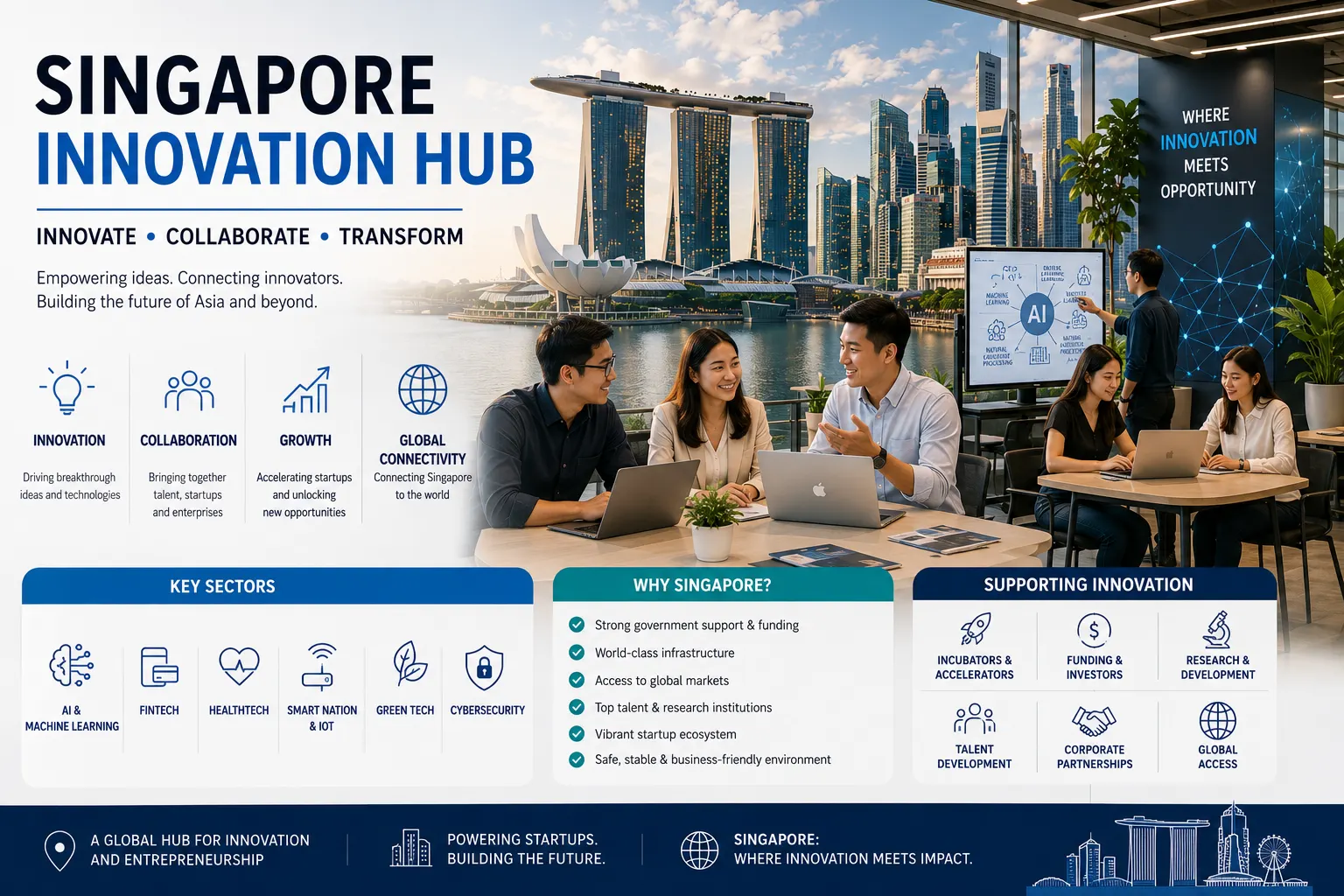
Singapore has always been known for its efficiency, strong infrastructure, and forward-thinking mindset. But in recent years, the city-state has taken another major step forward — transforming itself into a thriving Singapore Innovation Hub where businesses, researchers, startups, and global companies come together to create new solutions.
From artificial intelligence and biotechnology to smart city projects and sustainable technology, Singapore Innovation Hub is building an environment where innovation is not just encouraged. It is actively designed into the country’s future.
What makes Singapore Innovation Hub stand out is the way different sectors connect. Universities work with companies. Startups collaborate with government agencies. International investors find opportunities alongside local entrepreneurs.
It is a place where ideas can move quickly from a simple concept into a real-world application.
Here are the key reasons why Singapore Innovation Hub has become one of Asia’s most exciting innovation destinations.
1. A Strong Government Vision Supporting Innovation
One major reason behind Singapore’s rise as an innovation hub is its long-term planning. The country has consistently invested in research, technology, and digital transformation instead of waiting for changes to happen.
Government initiatives focus on helping companies experiment, test new technologies, and scale their solutions globally.
Programs supporting research and development have created opportunities in areas such as:
- Artificial intelligence
- Advanced manufacturing
- Digital finance
- Healthcare technology
- Climate solutions
- Smart urban development
Singapore’s approach is practical. Innovation is not treated as just a buzzword. It is connected to real problems that businesses and communities face.
For example, smart city technologies are tested in real environments, allowing companies to understand what works before expanding their solutions internationally.
That combination of planning and flexibility has helped strengthen Singapore’s reputation as a place where innovation can actually happen.
2. A Thriving Startup Ecosystem
A successful innovation hub needs entrepreneurs who are willing to take risks, experiment, and build new products.
Singapore Innovation Hub has developed a strong startup ecosystem supported by incubators, accelerators, investors, and technology communities.
The city attracts founders from around the world because it offers:
- Easy access to Asian markets
- Strong business regulations
- Reliable infrastructure
- Funding opportunities
- A highly skilled workforce
Many startups choose Singapore Innovation Hub as their regional headquarters because they can connect with customers and partners across Southeast Asia.
The startup environment is also becoming more diverse. It is no longer only about software companies. Today, entrepreneurs are building solutions in food technology, renewable energy, healthcare, education, and financial services.
And that is what makes the ecosystem interesting — innovation is happening across many industries at the same time.
3. World-Class Research and Education Institutions
A true innovation hub needs strong knowledge foundations. Singapore’s universities and research institutions play an important role in developing new ideas and technologies.
Institutions such as National University of Singapore Innovation Hub and Nanyang Technological University contribute significantly to research, entrepreneurship, and industry collaboration.
Students and researchers are encouraged to work on projects that solve practical challenges.
Areas of research include:
- Artificial intelligence
- Robotics
- Sustainable materials
- Biomedical sciences
- Data analytics
- Engineering solutions
The connection between education and industry is one of Singapore’s biggest strengths.
A research discovery does not have to stay inside a laboratory. It can become a commercial product, a startup idea, or a technology adopted by businesses.
4. A Global Destination for Technology Companies
Many international technology companies have established offices, research centres, or innovation facilities in Singapore.
The reason is simple: the country provides a stable environment where companies can develop and test new technologies while accessing the wider Asian market.
Singapore’s strategic location makes it an ideal gateway to countries such as Indonesia, Malaysia, Thailand, Vietnam, and the Philippines.
Global companies are attracted by:
- Political stability
- Strong intellectual property protection
- Excellent connectivity
- Skilled professionals
- Business-friendly policies
For many organisations, Singapore Innovation Hub is not just an office location. It becomes a regional base for innovation and expansion.
5. Leadership in Smart City Development
Singapore Innovation Hub itself functions as a living laboratory for innovation.
The country has invested heavily in smart city solutions that improve daily life, including transportation, public services, housing, and sustainability.
Examples include:
- Digital government services
- Smart traffic management
- Green building technologies
- Data-driven urban planning
- Autonomous vehicle testing
Because Singapore is compact and highly connected, new technologies can be introduced and evaluated efficiently.
A technology that improves public transport, reduces energy usage, or enhances urban living can be tested with real users.
This practical testing environment is one reason why the country attracts companies interested in developing smart city solutions.
6. Growing Focus on Artificial Intelligence and Digital Innovation
Artificial intelligence has become one of the biggest areas of growth within the Singapore Innovation Hub innovation landscape.
Companies and researchers are exploring AI applications in many industries, including:
- Healthcare diagnosis
- Financial services
- Manufacturing automation
- Customer experiences
- Cybersecurity
- Education technology
Singapore’s digital infrastructure supports these developments by providing strong connectivity and a technology-ready environment.
Businesses are also adopting AI tools to improve productivity and create new services.
But innovation is not only about creating advanced technology. It is also about using technology responsibly.
Singapore has placed attention on areas such as data protection, ethical AI use, and responsible digital development.
7. A Strong Environment for Sustainability Innovation
Climate challenges have pushed many countries to rethink how they build cities and operate businesses.
Singapore Innovation Hub has positioned itself as a centre for sustainability innovation, especially in areas where technology can create environmental improvements.
Innovation projects focus on:
- Renewable energy
- Water management
- Green buildings
- Sustainable transportation
- Carbon reduction solutions
Because Singapore Innovation Hub has limited natural resources, finding smarter ways to manage energy, water, and land has always been important.
This necessity has created opportunities for companies developing sustainable technologies.
In many ways, Singapore’s environmental challenges have become a reason for innovation rather than a limitation.
8. Strong Support for Collaboration and Partnerships
Innovation rarely happens alone.
The most successful ideas usually come from collaboration between different groups — startups, corporations, universities, investors, and public organisations.
Singapore encourages these partnerships through innovation districts, research centres, and business networks.
Spaces such as one-north have become important locations where companies and researchers work side by side.
These communities help create connections that may lead to new products, investments, and business opportunities.
Sometimes innovation begins with a simple conversation between people from completely different industries. Singapore’s ecosystem makes those conversations easier.
9. A Strategic Gateway to Asia
Location matters.
Singapore sits at the centre of Southeast Asia, one of the world’s fastest-growing economic regions.
For companies looking to expand into Asian markets, Singapore offers a strong starting point.
Businesses benefit from:
- International connectivity
- Regional trade links
- Multicultural talent
- Strong financial systems
A startup based in Singapore can access investors, customers, and partners across the region.
This global outlook has helped turn the country into more than a local technology centre. It has become a meeting point where ideas from different parts of the world come together.
10. The Future of Singapore as an Innovation Powerhouse
The journey of Singapore as an innovation hub is still evolving.
Future growth will likely come from emerging fields such as:
- Artificial intelligence
- Quantum technology
- Biotechnology
- Space technology
- Advanced robotics
- Sustainable solutions
The country’s advantage is not only its technology. It is the combination of people, infrastructure, research capability, and a willingness to experiment.
Innovation requires patience. Not every idea becomes successful. Some projects fail. Some take years before they create results.
But Singapore has built an environment where trying new things is possible.
Conclusion
The rise of the Singapore Innovation Hub reflects the country’s commitment to building a future-focused economy. Through strong research institutions, startup support, technology investments, and global partnerships, Singapore has created a place where innovation can grow.
It is not simply about having advanced technology. It is about connecting people, ideas, and opportunities in a way that creates meaningful change.
As industries continue to evolve, Singapore’s role as a centre for innovation will likely become even stronger — shaping not only Southeast Asia’s future but also contributing to global technological progress.