Singapore Housing Market: 10 Key Trends Shaping Property Prices, Demand
The Singapore Housing Market has always been closely watched by homeowners, investors, and even people planning their first property purchase. It is one of the most resilient property markets in Asia, supported by strong economic fundamentals, careful government planning, and a housing system that has evolved over decades.
But the market is not standing still.
After years of strong demand, rising home prices, cooling measures, and changing buyer preferences, Singapore’s property landscape is entering a new phase. Some buyers are becoming more cautious, while others are looking at long-term opportunities.
Whether you are a first-time homeowner, an upgrader, or simply curious about where Singapore property is heading, understanding the current trends can help you make better decisions.
Here are 10 important factors shaping the Singapore Housing Market today.
1. Housing Demand Remains Strong Despite Market Changes
One thing about Singapore property is clear — demand rarely disappears completely.
The country has a growing population, limited land supply, and a strong desire among residents to own homes. These factors continue to support housing demand across both public and private property segments.
The demand for Housing and Development Board (HDB) flats remains especially strong because they provide affordable homeownership opportunities for Singapore citizens. Many young couples continue to see buying an HDB flat as an important milestone.
At the same time, private properties attract buyers looking for larger living spaces, investment opportunities, and potential capital appreciation.
However, buyers today are more selective. They are paying closer attention to location, pricing, transport links, nearby amenities, and future development plans before making commitments.
The market is active — just more thoughtful.
2. HDB Resale Market Continues to Play a Major Role
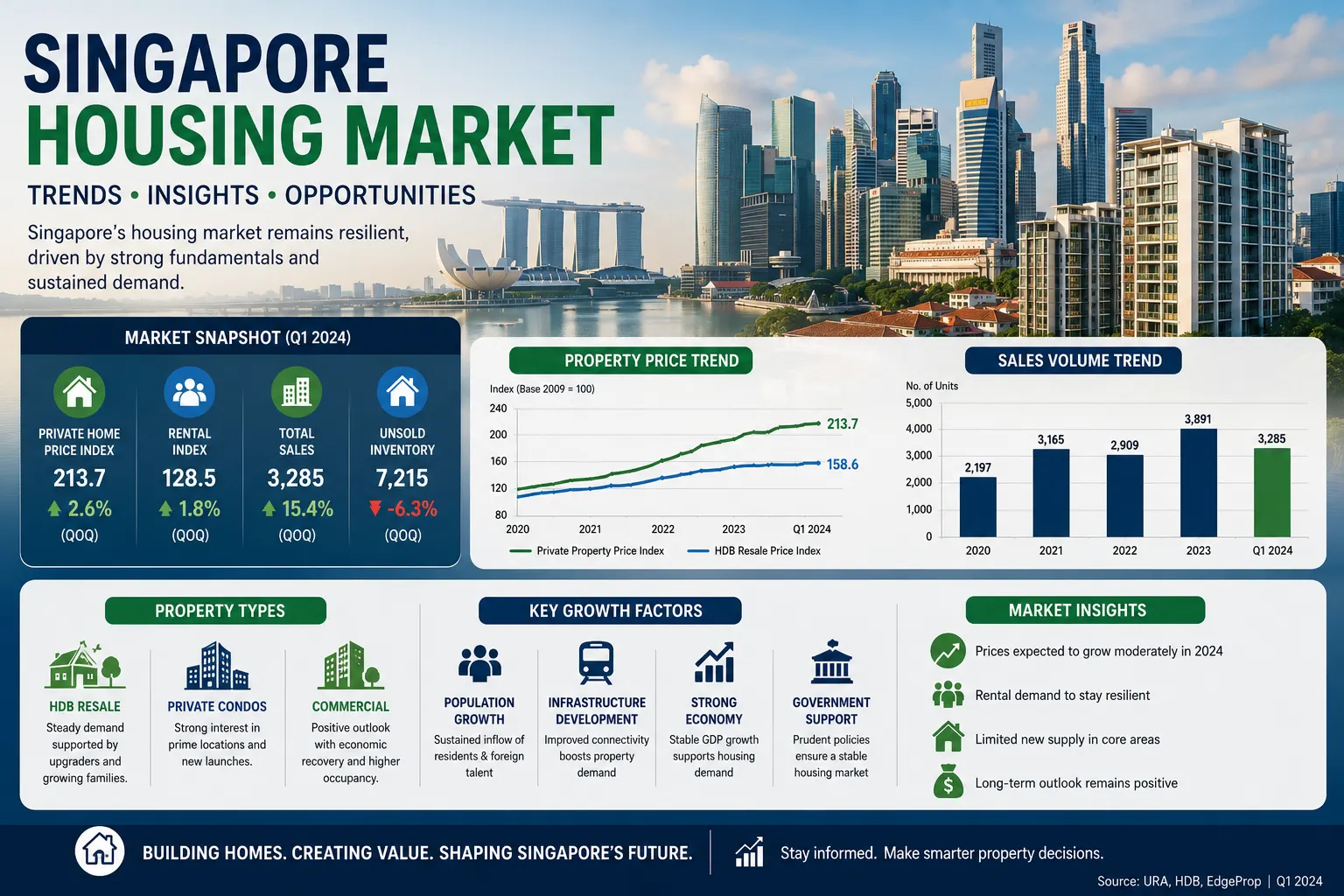
The HDB resale market remains one of the biggest parts of the Singapore Housing Market.
Over the past few years, resale flat prices experienced significant growth due to strong demand, limited supply of completed homes, and changing lifestyle needs. Many buyers preferred resale flats because they could move in faster compared to waiting for new Build-To-Order (BTO) projects.
Some flats, especially those located near MRT stations, schools, and popular neighbourhoods, continued to attract strong interest.
But affordability has become a major conversation.
Government policies, grants, and cooling measures aim to ensure housing remains accessible for Singaporeans. Buyers are increasingly considering whether a flat’s price matches its remaining lease, location benefits, and future resale potential.
Not every expensive flat automatically means it is a good investment.
3. Private Property Prices Face a More Balanced Environment
The private housing sector has seen impressive growth over the years. Condominiums, executive condominiums, and landed properties have attracted both local and foreign buyers.
However, the pace of growth has started to become more measured.
Higher interest rates, additional buyer taxes, and stricter regulations have influenced purchasing decisions. Some buyers are taking more time to compare options instead of rushing into purchases.
Developers are also becoming more careful with pricing strategies. New launches continue to attract attention, but buyers are increasingly looking beyond marketing campaigns and focusing on practical factors.
Things like:
- Distance to MRT stations
- School proximity
- Maintenance fees
- Unit layout
- Future development plans
These details matter more than ever.
4. Government Policies Continue to Shape the Property Landscape
Few housing markets are as closely managed as Singapore’s.
Government policies play a major role in maintaining stability and preventing extreme price fluctuations. Measures such as Additional Buyer’s Stamp Duty (ABSD), Loan-to-Value limits, and housing grants influence buyer behaviour.
These policies may sometimes feel restrictive, especially for investors or second-home buyers. But they are designed with a bigger goal — keeping housing sustainable for residents.
The Singapore government has consistently focused on balancing three priorities:
- Keeping homes affordable
- Supporting homeownership
- Maintaining a stable property market
Because of this approach, Singapore has avoided many of the sharp housing crashes seen in other countries.
5. Location Still Makes a Huge Difference
The old property saying “location, location, location” remains very relevant in Singapore.
Different neighbourhoods experience different levels of demand. Areas near business districts, established schools, shopping malls, and transport networks often attract stronger interest.
For example, properties near upcoming MRT lines or major urban redevelopment projects may see increased attention over time.
Buyers are also looking beyond traditional hotspots.
Newer towns such as Tengah and developments in the west and north are gaining interest because of improved infrastructure, smart town planning, and future connectivity.
A property’s value is not only about what exists today. It is also about what the area could become tomorrow.
6. Rising Interest Rates Have Changed Buyer Behaviour
Mortgage costs are an important factor affecting the Singapore Housing Market.
When interest rates rise, monthly repayments increase. This naturally makes buyers more cautious, especially those taking larger loans.
Many homeowners have started paying closer attention to:
- Fixed versus floating loan packages
- Monthly affordability
- Long-term financial planning
- Potential changes in interest rates
Previously, some buyers focused mainly on whether they could secure a property.
Now, they are asking a different question:
“Can I comfortably manage this home for the next 10 to 20 years?”
That shift in mindset is healthy. Property decisions are becoming less emotional and more financially calculated.
7. Changing Lifestyle Preferences Are Influencing Home Choices
The way people view homes has changed.
After the pandemic, many buyers started prioritising space, flexibility, and comfort. A home is no longer just a place to sleep — it is also an office, study area, relaxation space, and sometimes a place for multi-generational living.
Features that attract buyers today include:
- Larger layouts
- Flexible rooms
- Balcony spaces
- Good natural lighting
- Quiet surroundings
For younger buyers especially, lifestyle convenience matters. They want homes that fit their daily routines, not just properties that look attractive on paper.
8. Sustainability and Smart Living Are Becoming More Important
Singapore’s focus on sustainability is also influencing housing developments.
New residential projects increasingly include energy-efficient designs, green spaces, smart technology, and environmentally friendly features.
Smart homes are becoming more common too. Automated lighting, security systems, and energy monitoring solutions are slowly becoming part of modern living.
Future homeowners may place greater value on properties that offer lower energy costs and better environmental performance.
It is a small shift, but one that could reshape housing preferences over time.
9. Foreign Buyer Interest Remains a Key Market Factor
Singapore has long been attractive to international investors because of its political stability, strong legal system, and reputation as a global financial hub.
Foreign buyers continue to show interest in luxury homes and selected private properties.
However, cooling measures have changed the landscape. Additional taxes have made some purchases less attractive, particularly for overseas buyers.
As a result, the market has become more focused on genuine demand rather than speculative activity.
This creates a healthier environment where long-term value matters more.
10. The Future of the Singapore Housing Market Looks Stable, Not Predictable
Predicting property prices is never simple.
The Singapore Housing Market will continue to be influenced by economic conditions, interest rates, government policies, population changes, and global trends.
Some areas may experience stronger growth than others. Some property types may perform better depending on changing buyer needs.
But Singapore’s long-term strengths remain:
- Limited land supply
- Strong infrastructure
- Effective urban planning
- Stable governance
- High homeownership culture
These factors provide a strong foundation.
The market may experience periods of cooling and growth, but sudden extreme changes are less likely because of Singapore’s careful approach to housing management.
Final Thoughts on Singapore Housing Market Trends
The Singapore Housing Market is entering a more balanced stage where careful planning matters more than quick decisions.
For buyers, the key is understanding affordability, choosing the right location, and thinking long term. For investors, analysing market fundamentals is more important than chasing short-term price movements.
Property will always be a major part of Singapore’s economy and lifestyle. But the smartest decisions usually come from patience, research, and a clear understanding of personal goals.