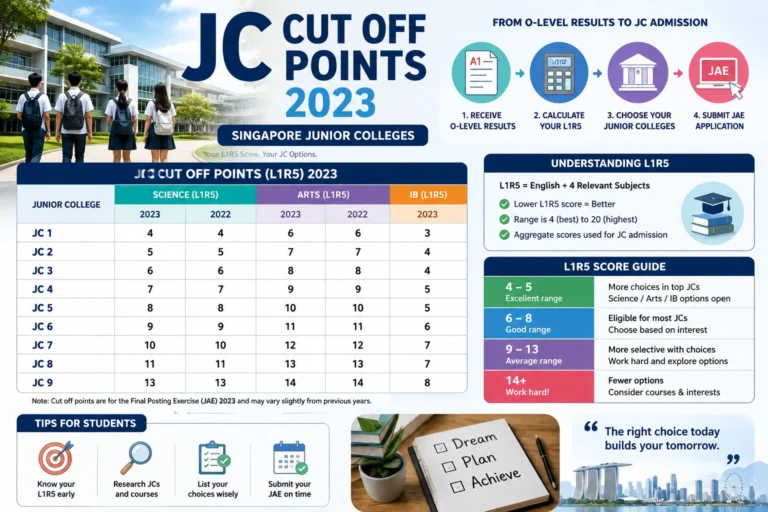

JC Cut Off Points 2026: Complete Singapore JC Admission Guide
After receiving O-Level results, students have to make an important decision about their next two years of education. For those considering Junior College, the JC Cut Off Points 2026 offer a useful reference when comparing different schools and courses. The Cut Off Point (COP) refers to the net L1R5 score of the last student posted to a particular course through the Joint Admissions Exercise (JAE). It can help students judge how competitive a JC was during the admission exercise, but it should not be treated as a guaranteed admission score. MOE notes that actual net aggregate scores depend on applicants’ results and course choices and can change from year to year.
This guide looks at the latest 2026 COP figures, explains the difference between Science and Arts courses, breaks down how L1R5 works, and shows how students can compare JC options based on their scores. It also covers practical JAE choice strategies for making a more balanced school list.
What Are JC Cut Off Points 2026?
JC Cut Off Points 2026 show the net L1R5 score of the last student posted to a particular Junior College course through the Joint Admissions Exercise (JAE). In simple terms, the COP gives students an idea of how competitive a course was during that year’s admission exercise. A lower score usually indicates stronger competition for the available places.

The COP is closely linked to the net L1R5 aggregate, which is the score used for JC posting after eligible bonus-point deductions. The final admitted student’s score becomes the reference point shown for that course. However, it is not a fixed entry requirement that applies every year. MOE states that actual course net aggregate scores depend on applicants’ O-Level results and course choices, so they can change from one JAE to another.
This means students should use the 2026 COP as a planning reference, rather than treating it as a guaranteed admission score. Changes in applicant performance, course demand and available vacancies can all affect the following year’s figures.
JC Cut Off Points 2026 for Singapore JCs
The 2026 JAE figures show a clear spread between Singapore’s most competitive Junior Colleges and those with broader admission ranges. At the higher end, Raffles Institution and Hwa Chong Institution remain especially competitive, with their Science courses reaching net L1R5 ranges of 2–3 and 2–4 respectively. Eunoia JC and Nanyang JC also sit near the top, with Science ranges reaching 5.
| Junior College | Science COP | Arts COP |
| Raffles Institution | 3 | 5 |
| Hwa Chong Institution | 4 | 5 |
| Eunoia Junior College | 5 | 6 |
| Nanyang Junior College | 5 | 7 |
| National Junior College | 7 | 8 |
| Victoria Junior College | 6 | 8 |
| Dunman High School | 7 | 8 |
| Temasek Junior College | 7 | 8 |
| Anglo-Chinese Junior College | 8 | 9 |
| River Valley High School | 8 | 9 |
| St Andrew’s Junior College | 9 | 10 |
| Anderson Serangoon Junior College | 10 | 11 |
| Catholic Junior College | 12 | 13 |
| Tampines Meridian Junior College | 12 | 13 |
| Jurong Pioneer Junior College | 14 | 15 |
| Yishun Innova Junior College | 18 | 19 |
The table uses the last-admitted net L1R5 score as the COP, based on published 2026 JAE admission ranges.
The biggest gap appears between the most competitive JCs and the mid-range group. Students targeting Raffles, Hwa Chong, Eunoia or Nanyang generally need a very strong net L1R5 score, while colleges further down the table have wider admission ranges. The Science and Arts figures can also differ within the same school. This is often linked to differences in demand and the number of places available for each course.
A higher COP does not mean that a JC provides a weaker education. It simply indicates that students with higher net L1R5 scores were admitted at the end of that particular JAE exercise. For students comparing schools, the COP is best used as a reference point alongside subject combinations, school environment, travel distance and future study plans. Since admission patterns can shift each year, the 2026 figures should not be treated as permanent entry requirements.
Which JC Has the Lowest Cut Off Point in 2026?
Among the 2026 JC admission figures, Raffles Institution has the lowest Science COP at 3, making it one of the most competitive JC courses for students entering through the JAE. Hwa Chong Institution follows closely, while Eunoia JC and Nanyang JC also sit within the lower COP range. For Arts, Raffles Institution and Hwa Chong Institution have a COP of 5, placing both among the most competitive choices for students interested in the humanities.
A one-point difference may look small, but it can matter when students are deciding between several JCs. A student with a net L1R5 of 5, for example, may have a stronger position at a JC with a COP of 6 than at one with a COP of 5. Still, the COP reflects the last student posted in that particular admission exercise, rather than a permanent requirement.
Students should also avoid picking a JC simply because it has the lowest number. A lower COP usually reflects stronger admission competition, not necessarily a better fit for every student. Subject combinations, school culture, CCAs, location, academic programmes and future university plans can all affect whether a JC suits an individual student. The most useful approach is to compare the 2026 COP with your own net L1R5 and then build a JAE list with a sensible mix of ambitious, realistic and safer choices.
Science vs Arts JC Cut Off Points
Science and Arts COPs can be different within the same JC because each course has its own demand, vacancies and applicant scores. MOE says JAE posting depends on net aggregate scores, available places and the number of applicants.
Science COP
Science courses often have competitive COPs, especially at popular JCs. Students interested in subjects such as Mathematics, Chemistry, Physics or Biology should compare the Science COP with their own net L1R5.
Arts COP
Arts COP can be higher or lower than Science at the same school. Demand for subjects such as Economics, History, Geography and Literature can affect the final admission score.

Why the Difference Matters
For example, if a JC has:
- Science COP: 5
- Arts COP: 7
A student should not use the Science figure to estimate their Arts admission chances.
Key Point for JAE Choices
Always check the COP for the stream you actually want. A JC’s Science COP does not automatically predict its Arts admission score. COPs are based on each year’s posting results and can change with applicant demand.
How Is the JC L1R5 Score Calculated?
L1R5 is the aggregate score used for admission to many two-year JC courses. Since a lower score is better, students with a smaller net L1R5 generally have a stronger position when competing for places.
L1: Language Subject
L1 refers to the relevant language subject included in the aggregate. For most students, this is English Language or another eligible language subject.
R5: Five Relevant Subjects
R5 refers to the five relevant subjects used together with L1. The subjects must meet the requirements for the JC course being selected.
Gross L1R5
Your gross L1R5 is calculated before eligible bonus-point deductions. It gives the starting aggregate based on your O-Level grades.
Bonus Points
Eligible students may receive bonus-point deductions under the applicable admission schemes. These deductions can reduce the score used for JC posting.
Net L1R5
The basic calculation can be shown as:
Gross L1R5 → Eligible bonus-point deductions → Net L1R5
For example, if a student’s gross L1R5 is 8 and they receive 2 eligible bonus points, their net L1R5 becomes 6. That net score is then used when considering their JAE choices, subject to the relevant admission requirements.
Students should check the latest MOE rules because bonus-point eligibility and admission requirements can vary by scheme and course.
What JC Can You Get With Your L1R5 Score?
Your net L1R5 is one of the most useful numbers to consider when planning your JAE choices. It can help you identify JCs where your score is close to, or stronger than, the latest published COP. The 2026 figures below are a planning guide, not a promise of admission.
| Net L1R5 Range | Possible JC Choices | Admission Position |
| 2–3 | Raffles Institution, Hwa Chong Institution | Very competitive options |
| 4–5 | Eunoia JC, Nanyang JC | Strong position for several competitive JCs |
| 6–7 | National JC, Victoria JC, Dunman High, Temasek JC | Good range of choices |
| 8–10 | ACJC, River Valley High, St Andrew’s JC | Several realistic options |
| 11–12 | Anderson Serangoon JC, Catholic JC, Tampines Meridian JC | More suitable mid-range choices |
| 13–14 | Catholic JC, Tampines Meridian JC, Jurong Pioneer JC | Check the specific course COP |
| 15–20 | Jurong Pioneer JC, Yishun Innova JC | Wider options, subject requirements still apply |
What If Your L1R5 Is Higher Than the 2026 COP?
Having a net L1R5 that is higher than a JC’s 2026 COP means your score is weaker than the last-admitted score recorded for that course. For example, if a JC has a COP of 7 and your net L1R5 is 8, your score is one point higher and you should treat that JC as a more challenging choice.
However, the previous COP should not be viewed as a permanent barrier. MOE explains that actual posting scores can change according to applicants’ results, course choices, available vacancies and the number of applicants each year. Students with better net aggregate scores are considered first for available places.
What Should You Do With a Higher Score?
If your score is above the recent COP:
- Keep the JC only if you are comfortable with the admission risk.
- Add JCs where your score is closer to or better than the recent COP.
- Check the specific Science or Arts course you want.
- Build a JAE list with ambitious, realistic and safer choices.
A one-point difference does not tell the whole story, so use the 2026 COP as a reference when planning rather than treating it as a fixed admission rule.
Why JC Cut Off Points Change Every Year
JC Cut Off Points are not permanent numbers. They can move from one JAE to another because the final admission score depends on the applicants, their scores, course choices and the vacancies available. MOE confirms that applicants with better net aggregate scores are considered first for available places.
Number of Applicants
More students applying for a particular JC course can increase competition. If many applicants have strong scores, the final COP may become lower.
Student Performance
The overall strength of the applicant group also matters. A year with more students achieving strong O-Level results can affect the final admission scores.
Course Demand
Science and Arts courses may attract different levels of interest. Higher demand for one stream can lead to a different COP from another stream within the same JC.
Available Places
The number of vacancies also affects admission. When places are limited, students compete more closely for the available positions.
Choice Preferences
Students do not apply randomly. Their JAE choices influence where demand is concentrated, which can affect the eventual admission range.
COP Is Not a School Ranking
A useful way to read COP is as an admission demand indicator, not a school ranking. A lower COP shows that a course was more competitive in that JAE; it does not automatically mean the school is academically better than a JC with a higher COP.
How to Choose a JC Beyond Its COP
A low COP can make a JC look attractive, but it should not be the only factor behind your decision. Your preferred subjects, daily routine and future plans may matter just as much.
1. Subject Combinations
Choose a JC that offers the Science, Humanities or other subject combinations that match your interests and academic goals.
2. Distance From Home
A shorter daily commute can make your routine easier and give you more time for studying and rest.
3. CCAs
Check the JC’s CCA options and make sure they include activities that match your interests and abilities.
4. School Environment
Look for a learning style, school culture and student environment that suit your personality and study habits.
5. University Plans
Consider your future university course and choose JC subjects that support your intended degree and its entry requirements.
6. Academic Support
Look at teacher support, academic programmes, consultations and enrichment opportunities when comparing different JCs.

Smart JAE Choice Strategy for 2026
A smart JAE choice list should include a mix of ambitious, realistic and safer options rather than focusing only on famous JCs. Put 1–2 ambitious choices at the top where the recent COP is slightly stronger than your score, followed by 3–5 JCs with COPs close to your net L1R5, giving you a more realistic chance of admission. Use your remaining choices for JCs where your score is comfortably within or better than the recent COP range. Before submitting your choices, check the specific Science or Arts course, subject requirements, location and school environment. A long list of highly competitive JCs may look impressive, but it can leave you with fewer practical options if your score does not match their admission range. MOE allows students to indicate up to 12 choices in the JAE, so each choice should have a clear reason behind it.
Frequently Asked Questions
What are the JC Cut Off Points 2026?
They show the net L1R5 score of the last student posted to a JC course in the 2026 JAE.
Which JC has the lowest COP in 2026?
Raffles Institution has one of the lowest 2026 COPs, with a Science COP of 3.
Is a lower JC COP better?
A lower COP means stronger admission competition, but it does not automatically mean the JC is the best choice for every student.
Can I enter a JC if my L1R5 is higher than the COP?
It may be harder, but COPs are not permanent cut-offs and can change according to yearly applicant results and choices.
Do bonus points affect JC admission?
Yes, eligible bonus points can reduce your gross L1R5 to produce the net score used for posting.
What L1R5 score is needed for JC admission?
Students generally need a gross L1R5 of 20 points or better, along with the required subject grades for their chosen course.
Do JC COPs change every year?
Yes. The final COP depends on applicants’ results, course choices and available places in each JAE.
Should I choose a JC based only on its COP?
No. Compare the COP with subjects, school environment, CCAs, location and your future study plans before making your JAE choices.
Conclusion
The JC Cut Off Points 2026 give students a useful starting point when comparing Junior Colleges and planning their JAE choices. Your net L1R5 score helps you understand which schools may be realistic based on recent admission figures, but the COP should never be treated as a guaranteed entry score. Admission outcomes can change each year as applicant results, course demand and available places shift.
When choosing a JC, look beyond the COP and consider the subjects offered, academic support, school environment, CCAs, travel time and your future university plans. A strong JAE list should balance preferred schools with realistic alternatives, helping you find a JC that fits both your current score and your long-term goals.