Singapore Digital Government: 10 Ways It’s Transforming Everyday Life
Singapore has earned a reputation as one of the world’s most digitally advanced nations. Behind that success is a long-term commitment to building a government that puts technology at the center of public services—not for the sake of innovation alone, but to make daily life easier for residents and businesses.
From paying taxes online to accessing healthcare records, renewing licenses, or starting a business, digital services have become part of everyday life in Singapore.
But Singapore Digital Government isn’t just about websites and mobile apps. It’s about creating a connected ecosystem where agencies share information securely, services become proactive instead of reactive, and citizens spend less time dealing with paperwork.
Let’s explore how Singapore Digital Government is reshaping the country.
1. Digital Identity Makes Government Services Easier
One of the biggest achievements is the introduction of Singpass, Singapore’s national digital identity.
Instead of remembering different usernames and passwords for multiple government agencies, users log in once and securely access hundreds of digital services.
Today, Singpass supports:
- Tax filing
- CPF services
- Healthcare access
- Housing applications
- Immigration services
- Business transactions
- Banking integrations
This single digital identity reduces complexity while improving security.
2. Most Government Services Are Available Online
Long queues at government offices have become increasingly rare.
Residents can complete many important tasks online, including:
- Renewing passports
- Registering businesses
- Applying for grants
- Paying taxes
- Booking appointments
- Updating personal records
- Applying for permits
Many services that once required multiple office visits now take only minutes.
That’s a major improvement in convenience.
3. Smart Nation Supports Digital Government
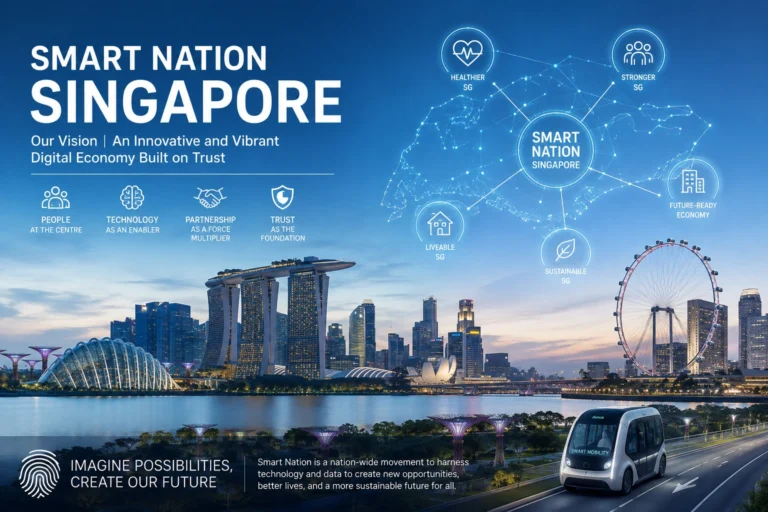
Singapore Digital Government is closely connected with the country’s Smart Nation initiative.
The idea is simple:
Use technology and data to improve public services, transportation, healthcare, education, and urban planning.
Examples include:
- Smart traffic monitoring
- Digital payment systems
- AI-assisted public services
- Cashless government transactions
- Smart sensors across the city
These technologies help agencies make faster and more informed decisions.
4. Government Services Are Becoming More Personalized
Rather than expecting citizens to search through dozens of websites, Singapore increasingly brings services directly to users.
For example:
Parents may receive reminders about vaccinations.
Seniors can access healthcare support.
Businesses receive notifications about grants or licensing deadlines.
The goal is proactive service delivery.
Instead of asking people to remember everything, government systems provide timely digital assistance.
5. Strong Cybersecurity Protects Digital Services
As more services move online, cybersecurity becomes essential.
Singapore invests heavily in:
- Secure authentication
- Multi-factor verification
- Data encryption
- Fraud detection
- Continuous monitoring
- Cyber resilience
Citizens also benefit from security alerts and authentication features that reduce identity theft risks.
Security remains one of the foundations of Singapore’s digital transformation.
6. Businesses Benefit from Faster Digital Processes
Singapore is consistently ranked among the easiest places in the world to start and operate a business.
Digital government contributes significantly.
Entrepreneurs can:
- Register companies online
- Apply for licenses digitally
- Submit tax documents electronically
- Access government grants
- Manage regulatory requirements
Small businesses especially benefit because administrative work takes less time than before.
And that means more time to focus on growth.
7. Healthcare Is Becoming More Connected
Digital healthcare continues expanding across Singapore.
Patients increasingly enjoy:
- Online appointments
- Digital medical records
- Prescription management
- Telehealth consultations
- Electronic referrals
Healthcare providers can access relevant information more efficiently, helping improve coordination while reducing paperwork.
For patients, it often means shorter waiting times and smoother care.
8. Artificial Intelligence Is Improving Public Services
Artificial intelligence now supports several government functions.
AI helps with:
- Customer service chatbots
- Document processing
- Traffic management
- Predictive analytics
- Resource planning
- Fraud detection
Importantly, AI is used to assist public officers rather than replace human judgment in sensitive decisions.
As AI technologies mature, Singapore continues exploring responsible ways to improve public service delivery.
9. Open Data Encourages Innovation
Government agencies publish valuable public datasets that researchers, developers, and businesses can use.
These datasets cover areas such as:
- Transport
- Environment
- Population statistics
- Urban planning
- Weather
- Economic indicators
Open access to data encourages innovation across universities, startups, and established companies.
Developers can build useful applications that solve real community problems.
10. The Future of Singapore Digital Government
Digital transformation isn’t slowing down.
Future developments may include:
- More AI-powered services
- Faster digital approvals
- Expanded digital identity capabilities
- Improved cross-agency integration
- Smarter public infrastructure
- Stronger cybersecurity protections
Citizens will likely experience services that feel increasingly seamless.
Sometimes government processes may happen automatically in the background without requiring multiple forms or repeated submissions.
That’s the direction many digital governments are working toward.
Singapore is already well along that path.
Why Singapore Digital Government Stands Out
Several factors contribute to Singapore’s global reputation in digital governance:
- Long-term planning
- Strong public trust
- High digital adoption
- Reliable infrastructure
- Continuous investment
- User-focused service design
- Robust cybersecurity
- Collaboration between agencies
Rather than introducing technology simply because it’s new, Singapore generally focuses on solving practical problems that improve everyday experiences.
That approach has helped create one of the world’s most efficient digital public sectors.
Final Thoughts
Singapore Digital Government demonstrates how thoughtful technology adoption can improve public services without making them more complicated.
Whether someone is renewing a passport, filing taxes, visiting a doctor, starting a company, or applying for government assistance, digital systems increasingly make these tasks faster, safer, and more convenient.
The journey continues. New technologies like artificial intelligence, cloud computing, and advanced cybersecurity will shape the next generation of public services. But the core objective remains the same: delivering accessible, secure, and citizen-centered government services that support people and businesses alike.