Singapore Urban Planning: 10 Smart Ideas That Make the City a Global Model
Walk through Singapore for a day, and you’ll notice something unusual. Parks blend into neighborhoods. Public transport feels connected. Housing estates have schools, clinics, shopping centers, and playgrounds within walking distance.
None of that happened by accident.
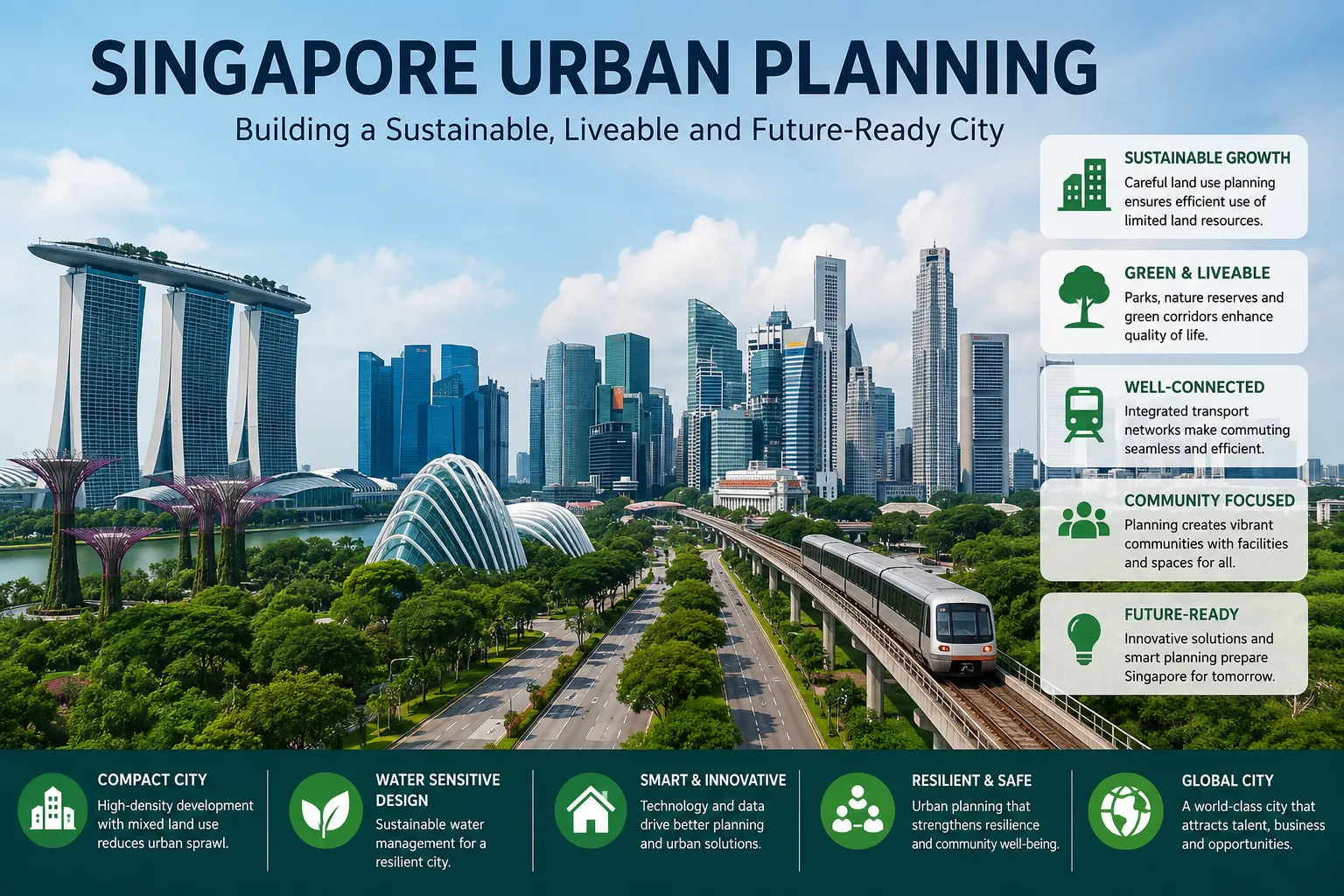
Singapore Urban Planning is the result of decades of careful thinking, long-term vision, and practical decision-making. Instead of reacting to problems after they appear, Singapore plans years—even decades—ahead. That’s one of the biggest reasons the country consistently ranks among the world’s most livable cities.
Let’s explore what makes Singapore’s planning approach so successful and why many countries continue to learn from it.
1. Long-Term Planning Is the Foundation
Perhaps the biggest strength of Singapore Urban Planning is its ability to think far into the future.
Instead of planning for the next election cycle, Singapore develops master plans that consider population growth, transportation, housing, businesses, and environmental needs years ahead.
The government regularly updates these plans to reflect changing lifestyles, technology, and economic trends.
This flexible approach means the city keeps improving instead of struggling to catch up.
2. Land Is Used Efficiently
Singapore is a small island with limited land.
That makes every square meter valuable.
Urban planners carefully decide how land should be used, balancing residential neighborhoods, business districts, parks, industrial zones, and public facilities.
Mixed-use developments have become especially popular.
Rather than separating homes, offices, restaurants, and shopping malls, many developments combine them into one integrated community.
The result?
People spend less time commuting and more time enjoying everyday life.
3. Green Spaces Are Everywhere
One of the most impressive parts of Singapore Urban Planning is its commitment to nature.
Despite being highly urbanized, Singapore has earned the nickname “City in Nature.”
Trees line major roads.
Parks connect through green corridors.
Vertical gardens decorate skyscrapers.
Even residential neighborhoods feature community gardens and walking trails.
These green spaces help reduce temperatures, improve air quality, and provide places where families can relax after busy workdays.
And honestly—it makes the city feel much calmer.
4. Public Housing Creates Strong Communities
Around 80% of Singapore’s residents live in public housing developed through carefully planned neighborhoods.
But these aren’t simply apartment blocks.
Each town includes:
- Schools
- Healthcare facilities
- Markets
- Parks
- Sports facilities
- Public transportation
- Shopping centers
Residents rarely need to travel far for daily essentials.
This neighborhood-first philosophy improves convenience while encouraging stronger community connections.
5. Public Transport Comes First
Many cities struggle with traffic.
Singapore took a different route.
Instead of encouraging endless road expansion, Singapore Urban Planning focuses heavily on efficient public transportation.
The MRT network continues expanding across the island.
Bus services connect nearly every residential area.
Cycling paths are increasing every year.
Walking routes are also designed to be comfortable and accessible.
The goal isn’t simply moving people.
It’s making travel easier, faster, and more sustainable.
6. Sustainability Shapes Every Decision
Modern cities face climate change, rising temperatures, and increasing energy demands.
Singapore addresses these challenges through sustainable planning.
Examples include:
- Green buildings
- Solar energy installations
- Water recycling systems
- Rainwater collection
- Energy-efficient construction
- Climate-resilient infrastructure
Developers are encouraged to meet environmental standards while maintaining economic growth.
It’s a balancing act…
And Singapore handles it remarkably well.
7. Technology Makes the City Smarter
Singapore Urban Planning increasingly relies on digital technology.
Urban planners use data to understand traffic patterns, housing demand, energy usage, and population growth.
Smart traffic management reduces congestion.
Digital monitoring improves public services.
Sensors help maintain infrastructure before problems become serious.
Technology doesn’t replace planning.
It simply helps planners make better decisions.
8. Waterfronts Have Been Transformed
Singapore has completely reimagined many of its waterfront areas.
Places that once supported shipping and industry now feature:
- Parks
- Entertainment districts
- Restaurants
- Walking promenades
- Residential developments
Marina Bay is one of the best examples.
What was once reclaimed land has become one of Singapore’s most recognizable urban destinations.
It shows how thoughtful planning can completely transform underused spaces.
9. Urban Planning Supports Economic Growth
Cities aren’t only places to live.
They’re engines of economic development.
Singapore carefully plans commercial districts, financial centers, innovation hubs, logistics facilities, and industrial parks.
Business districts are supported by excellent transportation and modern infrastructure.
This attracts international companies while creating employment opportunities for residents.
Economic planning and urban planning work hand in hand.
That connection is often overlooked.
10. Planning Never Really Stops
Here’s something many people don’t realize.
Singapore Urban Planning isn’t a finished project.
It’s constantly evolving.
Population needs change.
Technology advances.
Climate challenges grow.
New industries emerge.
Urban planners regularly review policies, update development strategies, and redesign neighborhoods where necessary.
This continuous improvement mindset keeps Singapore competitive while maintaining a high quality of life.
Challenges Facing Singapore Urban Planning
Even successful cities face challenges.
Singapore continues working to address issues like:
- Limited land availability
- Aging population
- Climate adaptation
- Rising housing expectations
- Increased transportation demand
- Maintaining biodiversity during urban growth
None of these challenges have simple solutions.
But Singapore’s planning philosophy emphasizes preparation rather than reaction, making it easier to adapt over time.
What Other Cities Can Learn
Many countries study Singapore Urban Planning because its principles can be adapted almost anywhere.
Some valuable lessons include:
- Plan decades ahead instead of only solving today’s problems.
- Integrate housing, transportation, and public services.
- Protect green spaces while encouraging development.
- Use technology to improve city management.
- Build neighborhoods that prioritize people rather than cars.
- Continuously review and improve urban strategies.
These ideas aren’t limited to Singapore.
They’re becoming increasingly relevant worldwide.
The Future of Singapore Urban Planning
Looking ahead, Singapore continues investing in smarter infrastructure, greener buildings, autonomous transportation, renewable energy, and climate resilience.
Future developments are expected to include even more integrated communities where work, recreation, education, healthcare, and housing exist within the same districts.
Artificial intelligence, digital twins, and real-time city data may also play larger roles in planning future developments.
The vision remains remarkably consistent:
Create a city that’s efficient, sustainable, inclusive, and enjoyable for everyone.
Final Thoughts
Singapore Urban Planning stands as one of the world’s strongest examples of how thoughtful design can transform a small nation into a globally respected city.
Its success isn’t built on skyscrapers alone.
It’s built on long-term thinking, sustainable development, connected neighborhoods, reliable public transport, abundant green spaces, and a willingness to keep improving year after year.
Cities around the world continue to face rapid growth and environmental pressures. Singapore offers practical lessons that prove smart planning isn’t just about buildings—it’s about creating better lives for the people who call the city home.