Singapore Cybersecurity News 2026: Cyber Defence and Critical Infrastructure Security
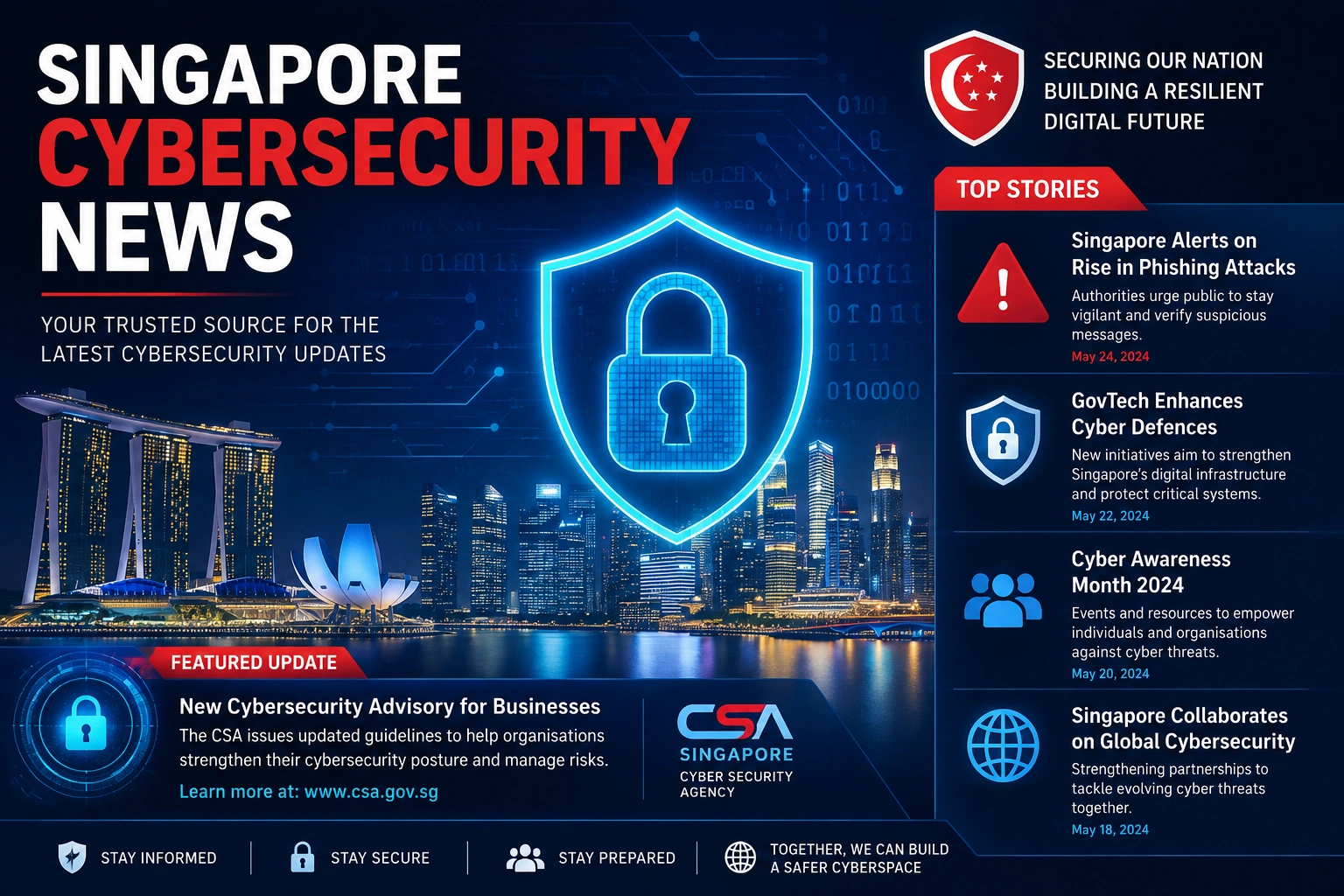
Singapore Cybersecurity News has become an important source of information as cyber attacks, data breaches, online scams and new digital threats continue to affect organisations and internet users across the country. Singapore’s highly connected economy makes cybersecurity a major concern for businesses, government agencies and everyday users.
Recent developments have brought attention to malware infections, ransomware, phishing campaigns, cyber espionage and attacks aimed at sensitive digital systems. The growing use of artificial intelligence has also changed the way attackers create convincing scams, target credentials and automate parts of their operations.
This page looks at the latest cybersecurity incidents and developments in Singapore, with a focus on what happened, who was affected and why each event matters. It also covers Singapore’s cyber defence efforts, major security risks, government alerts and practical steps that businesses and residents can take to reduce their exposure to cyber threats.
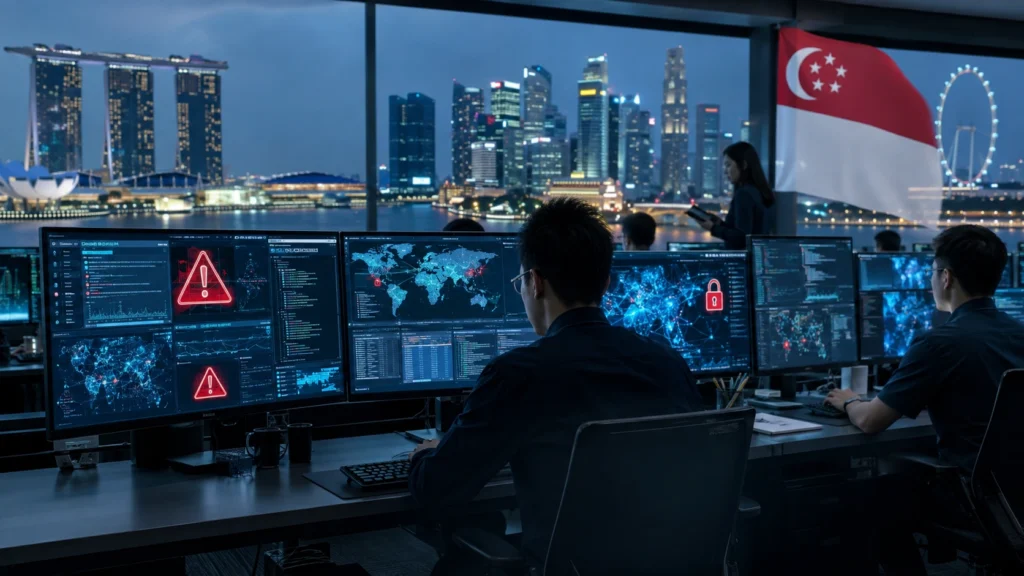
Singapore Cybersecurity News: Latest Updates in 2026
Singapore’s cybersecurity situation has continued to draw attention in 2026 as organisations face cyber attacks, data breaches, malicious software and targeted security threats. Recent incidents have involved telecommunications networks, public-sector data and widely used software, showing how different entry points can be used to reach Singapore-based systems.
Recent Cyber Attacks in Singapore
Several incidents reported in 2026 have involved targeted attempts to access networks and sensitive systems.
UNC3886 Cyber Attack on Singapore Telcos
A major cyber espionage incident involved UNC3886, an advanced persistent threat group that targeted Singapore’s four major telecommunications operators: Singtel, StarHub, M1 and SIMBA.
Key points:
- The activity involved sophisticated cyber intrusion techniques.
- Telecommunications networks were the main target.
- Singapore authorities worked with the affected telcos to investigate the activity.
- More than 100 cyber defenders were involved in the coordinated response.
- Authorities found no evidence that customer records were accessed.
- Telecommunications services were not disrupted.
The incident showed why telecommunications security remains a major part of Singapore’s cyber defence efforts.
Cyber Attacks Affecting Other Sectors
Cybersecurity incidents have also affected organisations outside telecommunications. Education, software and public-sector services have faced different types of security risks, including unauthorised access, malicious software and vulnerabilities in third-party systems.
These incidents matter because an attack does not always start inside the main organisation. Attackers can also look for weaknesses in suppliers, software packages, cloud environments or employee accounts.
Recent Data Breach and Security Incidents
Data exposure has remained another major concern in Singapore cybersecurity news.
A July 2026 incident involving the Singapore Land Authority and its vendor IBM affected information linked to around 70,000 people. The compromised dataset contained personal details, including names, NRIC numbers and previous property addresses.
Main Risks From Data Breaches
- Personal information can be exposed or misused.
- Stolen credentials may support further attacks.
- Organisations can face investigation and recovery costs.
- Customers may become targets of follow-up phishing or impersonation scams.
- Third-party vendors can create additional security risks.
This is why Singapore data breach incidents are relevant not only to government agencies but also to companies that store customer or employee information.
Latest Cybersecurity Alerts and Advisories
The Cyber Security Agency of Singapore (CSA) continues to issue cybersecurity alerts and security advisories covering vulnerabilities, malware, exposed credentials, scams and emerging threats.
Recent advisories have included warnings related to:
- FortiGate credential exposure
- Malicious software packages
- Microsoft impersonation scams
- Malware and security vulnerabilities
- Autonomous and agentic AI security risks
For businesses and IT teams, these advisories can provide early warnings about vulnerabilities that may affect their systems or software.
What These Incidents Tell Us
The latest Singapore cybersecurity updates point to several recurring risks:
- Cyber attacks: Threat actors are targeting important networks and organisations.
- Data breaches: Personal and business information remains a valuable target.
- Supply-chain risks: Third-party software and vendors can introduce security weaknesses.
- Credential theft: Stolen usernames and passwords can provide attackers with another route into systems.
- AI-related threats: Attackers are using new AI capabilities to improve scams and automate parts of cyber attacks.

Table: Latest Singapore Cybersecurity Incidents
| Date | Incident | Threat | Affected Sector | Impact |
| February 2026 | UNC3886 activity targeting four major telcos | Cyber espionage | Telecommunications | Network intrusion; no evidence of customer data access |
| April 2026 | Axios software supply-chain compromise | Malicious software | Software / Businesses | Potential risk for users of affected versions |
| May 2026 | Canvas cyberattack | Cyber attack | Education | Singapore institutions assessed potential exposure |
| June 2026 | FortiGate credential compromise advisory | Credential exposure | Business / Network systems | More than 70,000 devices affected globally |
| July 2026 | SLA-related data incident | Unauthorised access | Public sector / Vendor | Information linked to about 70,000 people compromised |
Major Cybersecurity Threats Facing Singapore
Singapore’s connected economy faces several forms of cyber risk, from simple phishing messages to targeted attacks against business networks and important digital systems. The threat picture also includes ransomware, malware, cyber espionage, stolen credentials and weaknesses in cloud or third-party systems.
Phishing and Social Engineering
Phishing remains a common way for attackers to approach users before attempting to access an account or network. A message may appear to come from a bank, government agency, employer or familiar company, making it harder for the recipient to spot the warning signs.
Common Phishing Methods
- Fake emails: Messages may direct users to a fraudulent login page or ask them to open an unsafe attachment.
- SMS scams: Short messages can contain fake delivery, banking or account-verification links.
- Impersonation: Attackers may pretend to be officials, company employees or technical-support staff.
- Credential theft: Stolen usernames, passwords and authentication details can later be used for unauthorised access.
Social engineering adds another layer because the attacker tries to influence the victim rather than relying only on technical weaknesses. This makes awareness important for both employees and individual users.
Ransomware and Malware
Ransomware and malware can cause serious problems for organisations when malicious software reaches computers, servers or other connected systems. Ransomware may lock files or systems and demand payment, while other malware can steal information, monitor activity or provide attackers with remote access.
Main Risks From Malware Attacks
- Ransomware attacks: Files or systems may become inaccessible.
- Malware infections: Malicious programs can compromise devices and networks.
- Data theft: Attackers may collect sensitive business or customer information.
- Business disruption: An infected system can interrupt normal operations.
- Further network access: A compromised device may become an entry point for attacks on other systems.
For Singapore businesses, these risks can affect operations, customer information and internal systems at the same time.
Cyber Espionage and Advanced Threats
Not every cyber incident is financially motivated. Cyber espionage Singapore cases can involve threat actors attempting to gain access to sensitive information, technical data or strategically important networks.
Advanced persistent threats, often called APT attacks, can remain hidden inside a network for extended periods. Attackers may first obtain access through a vulnerability, stolen credentials or a compromised device and then attempt to move deeper into the environment.
What Makes Advanced Attacks Difficult to Detect?
- Threat actors may use legitimate credentials.
- Network activity can be disguised as normal traffic.
- Attackers may target specific organisations rather than large numbers of random users.
- Unauthorised access can remain unnoticed until suspicious activity is identified.
- Compromised systems may be used to reach additional devices or services.
These incidents make monitoring, threat detection and timely cyber incident response important parts of Singapore’s cyber defence efforts.
Cloud and Network Security Risks
Businesses increasingly depend on cloud platforms, remote access and connected networks. This creates additional areas where security vulnerabilities can appear.
Common Cloud and Network Risks
- Weak access controls
- Exposed credentials
- Unpatched software
- Misconfigured cloud services
- Unprotected network devices
- Compromised third-party systems
- Unauthorised network intrusion
A weakness in one connected service can sometimes provide attackers with a route towards other systems. For this reason, organisations need to monitor both their own infrastructure and the external services they depend on.
Key Cyber Threats Singapore Organisations Need to Watch
The main risks can be grouped into four areas:
- Phishing and social engineering target people through deception.
- Ransomware and malware target devices, files and business systems.
- Cyber espionage and APT attacks focus on sensitive networks and information.
- Cloud and network vulnerabilities can expose connected systems to unauthorised access.
How AI Is Changing Cybersecurity in Singapore
Artificial intelligence is changing the cybersecurity threat picture in Singapore in 2026. Attackers can use AI to create convincing messages, study potential targets and automate parts of their campaigns. This can make cyber attacks faster and harder to recognise, especially when traditional phishing and social engineering techniques are combined with AI tools.
AI-Powered Cyber Attacks
AI-assisted attacks can help threat actors prepare targeted campaigns with less manual effort. Automated tools may generate realistic emails, messages and other content based on information about a target. This creates new AI cybersecurity risks for Singapore businesses, particularly when employees receive highly personalised phishing attempts that appear to come from trusted contacts or organisations.
AI Phishing and Deepfake Scams
AI is also making scams more convincing. Attackers can create natural-sounding messages, clone voices and produce realistic images or videos for impersonation. Deepfake scams in Singapore can be used to imitate company executives, public figures, family members or customer-service representatives. A victim may be pressured to transfer money, reveal account details or follow a malicious link because the communication appears genuine.
Agentic AI and New Security Risks
Agentic AI is another area receiving attention because autonomous AI systems can perform tasks with limited human involvement. If an AI agent has access to business information, applications or external services, poor controls could create opportunities for misuse. Security teams therefore need to consider permissions, connected tools, sensitive information and the actions an AI system is allowed to perform.
AI for Cyber Defence
AI can also support the defensive side of cybersecurity. Security teams can use AI-assisted systems to monitor network activity, identify unusual behaviour and analyse large volumes of security data. AI tools may also help analysts investigate alerts and support incident response. Human oversight remains important when these systems handle sensitive information or make security-related decisions.
For Singapore, AI creates a two-sided cybersecurity challenge. Organisations need to defend against AI-powered attacks while also protecting their own AI systems from manipulation, unauthorised access and misuse.
| Cyber Threat | Common Target | Main Risk | Typical Impact |
| Phishing | Individuals, employees and businesses | Credential theft | Account compromise and fraud |
| Social engineering | Employees and users | Unauthorised access | Stolen information or credentials |
| Ransomware | Businesses and organisations | Locked or encrypted data | Operational disruption and recovery costs |
| Malware | Devices and networks | System compromise | Data theft, surveillance or further intrusion |
| Cyber espionage | Government, telecoms and strategic organisations | Sensitive information theft | Intelligence gathering and network compromise |
| APT attacks | High-value organisations | Long-term network access | Data exposure and persistent intrusion |
| Cloud security threats | Businesses using cloud services | Exposed data or accounts | Unauthorised access |
| Network intrusion | Connected systems | System compromise | Data theft and service disruption |
| Security vulnerabilities | Software, devices and platforms | Exploitation by attackers | Unauthorised access or malware infection |
Major Cyber Attacks and Data Breaches in Singapore
Recent Singapore cyber attack news shows that threats are affecting telecommunications, public-sector data and software systems. A few notable incidents stand out in 2026.
UNC3886 Cyber Attack on Singapore Telcos
What happened: UNC3886 targeted Singtel, StarHub, M1 and SIMBA using advanced intrusion techniques.
Threat: Cyber espionage and APT activity.
Impact: Attackers gained limited network access, but authorities found no evidence of customer data theft or service disruption.
Response: CSA and other agencies worked with the telcos through Operation CYBER GUARDIAN to contain the threat and strengthen monitoring.
Singapore Land Authority Data Breach
What happened: Unauthorised access affected an IBM-managed environment containing a development and testing dataset.
Affected: Information linked to around 70,000 people.
Threat: Data exposure and unauthorised access.
Impact: Names, NRIC numbers and previous property addresses were compromised.
Response: IBM revoked access, while SLA worked with relevant authorities to investigate the incident.
Axios Software Supply-Chain Attack
What happened: Attackers compromised an npm maintainer account and released malicious versions of the Axios JavaScript package.
Threat: Software supply-chain attack.
Impact: Organisations using affected versions faced potential malware and system compromise risks.
Response: CSA issued an advisory and recommended affected organisations review their systems and take appropriate security measures.
These recent cyber incidents in Singapore show that security risks can come through direct attacks, exposed data and third-party software. Organisations need to monitor both their internal systems and the services they depend on.
Singapore Government Cybersecurity Response
1. Cyber Security Agency of Singapore
CSA Singapore leads national cyber defence efforts and publishes cybersecurity alerts, advisories and threat updates.
2. SingCERT and Incident Response
SingCERT supports organisations during cyber incidents by providing technical guidance, security reporting and incident-handling support.
3. Critical Infrastructure Protection
Singapore protects critical information infrastructure, including telecommunications, financial services and important digital systems, from cyber attacks and network intrusion.
4. Cybersecurity Regulations and Policies
Singapore’s cybersecurity policies support stronger cyber resilience, risk management and protection of important digital services across the country.
Cybersecurity Risks for Singapore Businesses and SMEs
1. Data Breaches
Customer and business information can be exposed through weak security or unauthorised access.
Strong access controls can reduce the risk of sensitive data being stolen.
2. Ransomware
Ransomware can lock business files and interrupt daily operations.
Secure backups can help companies recover after an attack.
3. Credential Theft
Stolen passwords can give attackers access to email, cloud accounts and business systems.
Multi-factor authentication adds another layer of account protection.
4. Cloud Security
Misconfigured cloud services can expose sensitive business information.
Regular security checks can help identify exposed accounts and permissions.
5. Third-Party Risks
Vendors and external software can create additional entry points for attackers.
Businesses should review vendor access and security practices regularly.

How Singapore Residents Can Stay Safe From Cyber Threats
Singapore residents can reduce common cyber risks by following a few simple security habits. These steps can help protect personal accounts, financial information and devices from phishing, scams and unauthorised access.
1. Use Strong Passwords
Use a different, strong password for each important account. Avoid using names, birthdays or easily guessed information.
2. Enable MFA
Turn on multi-factor authentication for email, banking, social media and other important accounts. It adds another verification step if a password is stolen.
3. Check Suspicious Messages
Verify unexpected emails, SMS messages and social media requests before responding. Do not share passwords, banking details or OTPs with anyone.
4. Avoid Unknown Links
Do not open suspicious links or attachments from unknown senders. Visit the official website or app directly when checking an account.
5. Be Careful With Unexpected Calls
Scammers may pretend to be bank staff, government officers or technical-support representatives. End the call and contact the organisation through its official channel.
6. Keep Devices Updated
Install security updates for phones, computers and apps when they become available. Updates can fix known security vulnerabilities.
7. Report Suspicious Activity
If you notice unusual account activity, a suspicious transaction or possible identity theft, report it quickly through the appropriate official channel.
What to Watch in Singapore Cybersecurity Next
The Singapore cyber threat landscape is likely to remain focused on both traditional attacks and newer AI-related risks. AI-driven cyber threats may make phishing, impersonation and automated attacks easier to scale, while agentic AI could introduce new security concerns when autonomous systems connect to business data and applications.
Key Areas to Watch
- AI-driven threats: More convincing phishing, scams and automated attacks.
- Agentic AI: New risks linked to autonomous AI systems and connected tools.
- Critical infrastructure: Telecommunications, financial services and other important systems may remain attractive targets.
- Cloud security: Misconfigured services and exposed accounts can create entry points for attackers.
- Cyber espionage: Advanced threat actors may continue targeting sensitive networks and information.
- Data protection: Businesses will need stronger controls around personal and customer information.
- Cyber resilience: Singapore’s cyber resilience strategy will remain important for preparing for and responding to incidents.
- Emerging vulnerabilities: New weaknesses in software, devices and digital platforms can create fresh attack opportunities.
Singapore Cybersecurity News FAQs
1. Is Singapore at risk of cyber attacks?
Yes. Singapore faces threats such as phishing, ransomware, malware, data breaches and cyber espionage.
2. What are the latest cybersecurity threats in Singapore?
AI-driven attacks, ransomware, phishing, supply-chain risks and attacks on critical infrastructure are major concerns.
3. What are the biggest cyber attacks in Singapore?
Recent incidents include attacks targeting telecommunications networks and data exposure involving public-sector systems.
4. What are the most common cyber scams in Singapore?
Phishing, SMS scams, banking scams, impersonation and fake technical-support scams are common threats.
5. How is Singapore protecting against cyber attacks?
CSA Singapore, SingCERT and other agencies monitor threats, issue advisories and coordinate responses to major cyber incidents.
Final Thoughts
Singapore’s cybersecurity situation continues to change as organisations face phishing, ransomware, data breaches, cyber espionage and new AI-driven threats. Recent incidents show that attackers can target telecommunications networks, business systems, personal information and third-party software.
For businesses and residents, basic security practices still matter. Strong passwords, multi-factor authentication, regular updates, secure backups and careful handling of suspicious messages can reduce common risks. At the national level, Singapore’s cybersecurity agencies and industry partners continue to monitor threats and respond to major incidents.
Keeping track of Singapore Cybersecurity News can help businesses and individuals understand new risks before they become a larger problem. With AI-related threats and emerging vulnerabilities gaining attention, regular security updates and better cyber awareness will remain important for Singapore’s digital environment.